
Asset Detector: Minister Jevšek’s Garage that Grew into a Pannonian House
Samo Demšar, Meta Gantar
—
In 2021, the Murska Sobota Administrative Unit issued a permit to the then mayor of Murska Sobota, now Minister of Cohesion, Aleksander Jevšek, to build a small partially open garage with a canopy. About a year later, a building that is almost half too large and resembles a Pannonian house stands on the site of the planned garage.

Illustration: Istvan David
In eastern Slovenia, near the Slovenian-Hungarian border lies the village Filovski Gaj. Since 2014 some of the plots in the village have been designated cultural monuments of local importance, due to their winegrowing tradition and preserved old wine cellars. Among them are plots – few without vineyards in this area – where the Minister of Cohesion and Regional Development, Aleksander Jevšek, former mayor of Murska Sobota, keeps a holiday home.*
It’s only a good twenty minutes’ drive from his home in Murska Sobota. Next to it, at least since mid-2022, stands a building that is supposed to be a ‘garage’ but in reality looks like another small house with a thatched roof, plastered with clay and lime-washed.
The floor plans, part of the project documentation for this building, display a semi open garage with a canopy. However, during Oštro’s site inspection, it appeared that the building deviated from the plans, as well as from other items specified in the building permit.
The building inspectorate hasn’t initiated an inspection procedure thus far. They explained that “the matter has not yet been prioritized for consideration”.**
How we searched and found
Oštro’s journalists visited Filovski Gaj this spring when we were updating information about the assets of ministers and other political officials as part of the Asset Detector project.

On the left is the holiday home co-owned by the Jevšek couple, and on the right the building that was supposed to be just a garage. Photo: Oštro
We first published information about Mr. Jevšek’s assets in May 2023, when the project was launched. At that time Oštro journalists identified only a single-family house in Murska Sobota owned by the minister and his wife. Mr. Jevšek was one of seven ministers who did not provide substantive answers to journalists’ questions about their assets.
In August last year, Forbes online media drew attention to the existence of another property owned by the minister. In the context of real estate holdings of government members recorded in the Asset Detector, the Ministry of Cohesion explained that the Jevšek couple also owned a weekend house in Filovci, a settlement in the municipality of Moravske Toplice.
We confirmed this information at Oštro after reviewing sizeable publicly available data on properties in Filovci. Since 2011 and 2015 respectively, Aleksander Jevšek and his wife have been co-owners of a vacation home and six surrounding plots of land, declared cultural monuments of local importance in the municipality of Moravske Toplice.
Satellite images show that, in addition to the holiday home, there is another building on the minister’s plots in Filovci, which, according to the building permit issued, should be a partially open garage with a canopy, but rather resembles a two-storey Pannonian residential house.
According to data from the online portal of the Surveying and Mapping Authority, the ‘garage’ is not registered in the real estate cadastre. It extends across four of Mr. Jevšek’s plots, which are classified as agricultural land.
Judging by historical satellite images from Google Earth, construction of the planned garage began between February and June 2021, most likely in April 2021. At the time, the Murska Sobota Administrative Unit issued Mr. Jevšek, who was still the mayor of Murska Sobota, a permit to build a garage with an area of 30.4 square meters, not on four plots but on three.
The additional plot onto which the building was “extended” is majority-owned by Mr. and Mrs. Jevšek, with one-eighth owned by a third party who should have agreed to the construction on this land, but judging by the building permit didn’t do so.
Nor did it notify its timely participation in the procedure for issuing a building permit for the construction of a garage on the three neighbouring plots. However in this case, under the building law in force at the time, it was considered to have agreed to the latter.
The construction was completed in June 2022, at a time when Mr. Jevšek swapped his mayoral position with the leadership of the Government Office for Development and European Cohesion Policy, later transformed into a ministry.
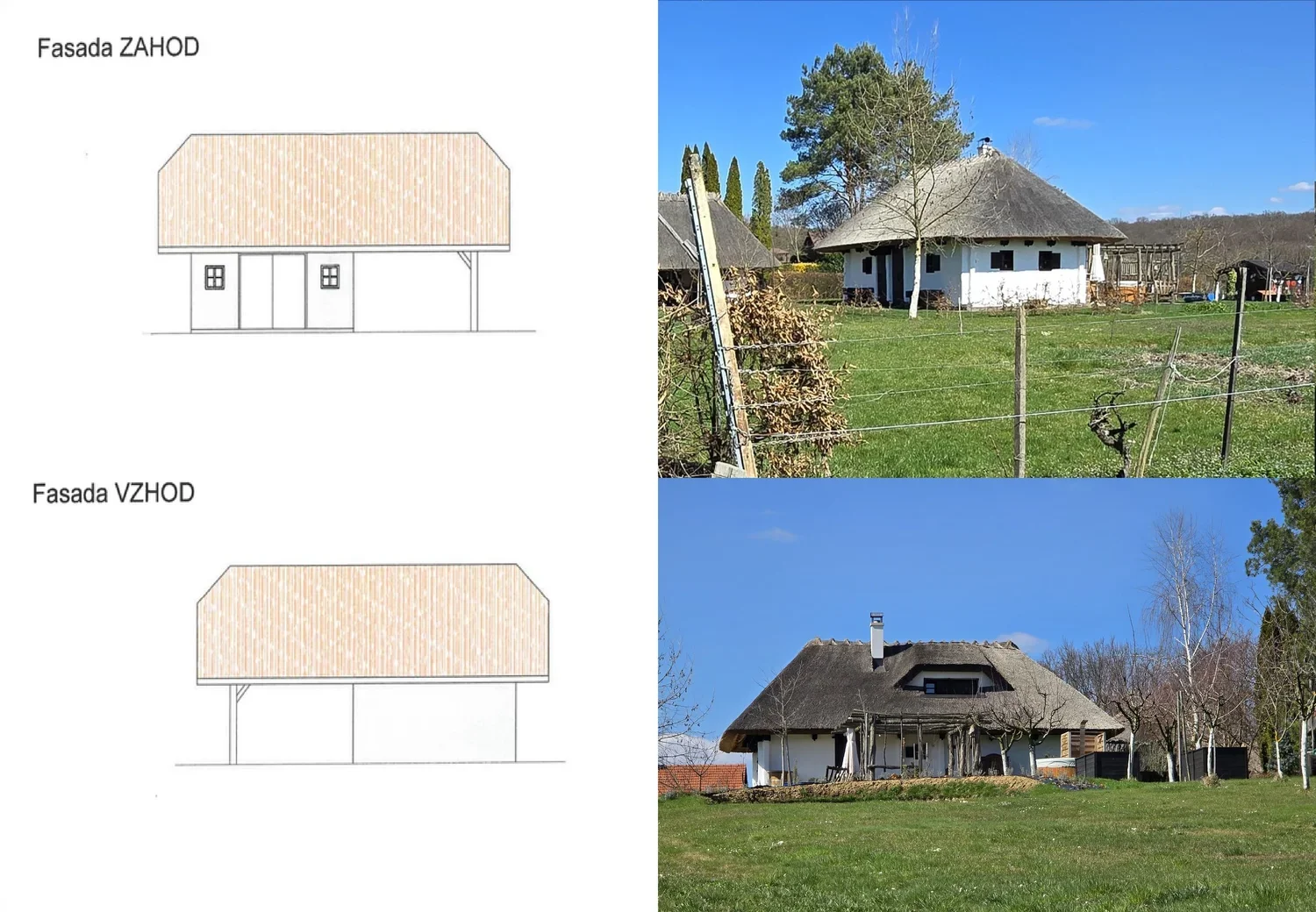
Comparison of floor plan sketches and the constructed building. Photo: screenshot of the Murska Sobota Administrative Unit document (left), Oštro photograph (right)
Minister Jevšek’s creative interpretation of the building permit
The Murska Sobota Administrative Unit confirmed to Oštro that the roof surface of the building for which they had issued a building permit should be 57 square meters. However, according to projections from two different applications for measuring building areas on satellite images, the roof surface of the constructed building is between 93 and 101 square meters, which is almost half more than permitted.
Though according to the building permit, the simple building or garage should only have one floor, the attic window indicates it was built on two floors. The municipal spatial plan for Moravske Toplice allows the construction of garages on land parcels, provided that there is a main building, or in this case a holiday home, on the neighbouring parcel. Smaller buildings must be single-storey and may not be used for residential purposes.

View of the ‘garage’ from the eastern side, with the canopy and terrace. Photo: Oštro
The building permit for Minister Jevšek’s ‘garage’ also stipulated that the investor must notify the administrative unit of the start of construction eight days before commencing and, upon completion, ensure that the building is registered in the building cadastre.
The administrative unit explained that the investor had not notified them of the start of construction under the building permit issued for three plots. For the fourth plot, which the building extends onto, they had not received any building permit application.
According to Article 98 of the Building Act in force at the time of construction of the building next to Mr. Jevšek’s holiday home, an investor who orders construction without a valid building permit, or fails to report the start of construction, is punishable by a fine between €1,000 and €3,000.
One of the two construction experts we spoke to said that investors often neglect to report the start of construction. The Inspectorate for Natural Resources and Spatial Planning, which oversees building inspections, explained to us that they do not keep records of how many inspection procedures they have initiated on the basis of violations of Article 98 of the Building Act.
The building permit for the three Jevšek plots further stipulated that the investor must ensure the newly constructed building is registered in the real estate cadastre, which he also failed to do. The national Surveying and Mapping Authority (GURS) explained that they had already detected the building in question, which at the time of writing still hadn’t been entered in the cadastre, using optical recognition of changes to buildings. This procedure is carried out yearly on the basis of aerial photographs and other spatial databases, each time covering approximately one third of Slovenia’s territory. The owner of the building will be invited to register it in accordance with the Real Estate Cadastre Act, they added.
“The administrative unit explained that the investor had not notified them of the start of construction under the building permit issued for three plots. For the fourth plot, which the building extends onto, they had not received any building permit application.”
According to Article 95 of the aforementioned law, the cadastral registration of buildings that don’t have the required permits still doesn’t mean that these buildings are legal. As explained by GURS, the registration of a building may only be an “indicator for further proceedings by the competent authorities”. These include the Construction Inspection Service, to which we first addressed our questions at the beginning of April.
Before receiving a building permit, Mr. Jevšek also had to obtain a cultural heritage opinion from the Maribor regional unit of the Institute for the Protection of Cultural Heritage (ZVKDS). As the institute stated to Oštro, it was issued for three plots of land, where the project documentation for the garage was in line with the construction conditions in Filovski Gaj as a cultural monument of local importance. No additional conditions for construction were prescribed.
In its opinion, the ZVKDS pointed out that intervention or construction is “permitted to the extent and in the manner specified in the submitted project documentation”. The cultural heritage opinion does not apply to the fourth plot of land on which the newly built structure also stands. After receiving our info, they announced a “field inspection of the situation” in the area in question.
The ball is in the building inspectorate’s court
According to the explanation of a second court expert in the field of construction for Oštro, before assessing whether the building is completely illegal or merely not in compliance with the building permit, it’s necessary to check the location information or the intended use of the plot, data on the actual construction and the building permit, as well as the urban planning conditions under which the permit was issued.
Due to the building next to the minister’s weekend home, which was supposed to be a garage with a canopy but has ended up as a small house, the Inspectorate for Natural Resources and Spatial Planning, which oversees building inspection, has not yet initiated an inspection procedure. They didn’t want to say when they would do so. “At any time, the inspectorate may receive a new report that, due to its nature, requires priority treatment,” they avoided giving a specific answer to our July inquiry. As already mentioned, we first addressed questions about Mr. Jevšek’s case to them in April.
“Upon reviewing the report, it was determined that the construction might not be in compliance with the issued building permit, and that the dimensions of the constructed building exceed those specified in the building permit.”
However, our inquiries were forwarded for review to the Inspectorate for Agriculture, Forestry, Hunting, and Fisheries, as well as the Inspectorate for Culture and Media. The building was namely constructed on agricultural land that is also a cultural monument of local importance.
The Agricultural Inspectorate found that the dimensions of the constructed building exceed those specified in the building permit. They concluded that there was suspicion of construction that did not comply with the issued building permit, but since the assessment and supervision of building construction doesn’t fall within their competence, but rather within the scope of the building inspectorate, they suspended the proceedings.
The Inspectorate for Culture and Media confirmed that they had initiated an inspection procedure in the case in question, but that it hadn’t yet been completed. They will inform us of their findings.
According to Article 66 of the Building Act in force when Mr. Jevšek’s ‘garage’ was built, minor deviations from the building permit are permissible, but only under certain conditions, so that: the changes to the construction are not such that the opinion of the competent authorities would differ from the original; the construction does not encroach on land not specified in the building permit; the external dimensions of the building are not changed by more than 0.3 meters; the essential requirements that were in force at the time of the building permit are met; and the type and purpose of the building are not changed.
In the event of deviations exceeding the above limitations, the investor must obtain an amended or new building permit.
In a sparsely worded response to journalists’ questions, Minister Aleksander Jevšek said that he was convinced that all the buildings in Filovski Gaj had been constructed legally. “I have been informed about the inspection procedure and am actively participating in it. I will provide all explanations within the framework of this procedure,” he added.
He did not comment on other information about his assets recorded in the Asset Detector.
*Update, July 28, 2025: The original version of the article used the term “built”. In 2013, the facade and roof of the building which serves as Minister Jevšek’s vacation home were renovated. The building had already been there in 2011 when he became its co-owner.
**The article in Slovene was published on July 28, 2025.