



We Have Expanded the Asset Detector with MEPs and Several Mayors
Today*, we published the asset data of MEPs, new government officials and MPs, and the first six mayors in the new edition of the Asset Detector. The mayors were selected through a public vote, but not everyone was thrilled with the outcome. The Municipality of Ljutomer namely reported Oštro to the Specialized State Prosecutor’s Office and the Information Commissioner.
The editorial team has so far only included six mayors in the expanded Asset Detector, but a pattern similar to the one characteristic of the national level, especially in the National Assembly where only 11 percent of MPs responded to journalists’ questions and just 15 percent submitted their asset declaration form, is already emerging at the local level as well.
Of the six mayors, two didn’t respond to journalists’ questions, two responded but not specifically, and two responded with concrete information. The only asset form received by Oštro was from Matjaž Švagan, mayor of Zagorje ob Savi, who has served the most consecutive terms among the mayors, having led the municipality for almost 33 years.
Issues are also evident with the registration of connected companies and private entrepreneurs on the list of entities subject to restrictions on business with the public sector (maintained by the Commission for the Prevention of Corruption). Many officials did not register connected entities.
We have recently expanded the Asset Detector with data on 33 officials, including six mayors, nine MEPs, and 18 new state secretaries, ministers or MPs taking office this year or last year.
Although MEPs are not required to submit their asset data to the KPK, five of them responded to journalists’ questions in detail, while three – Branko Grims, Milan Zver, and Zala Tomašič – didn’t respond at all.
Asset declaration forms were sent to the editorial office by MEPs Vladimir Prebilič and Matej Tonin (when he was still an MP), and state secretaries Srečko Đurov (Ministry of Cohesion and Regional Development), Andreja Kokalj (Ministry of Justice), and Andrej Sotošek (Ministry of Education and Science).
The Commission for the Prevention of Corruption (KPK) told us that Minister Ksenija Klampfer and Mayor Ivan Molan – as we understand it, after receiving questions from Oštro – registered connected entities on the list of entities with restrictions on business activities with the public sector, i.e., those connected with public officials.
“The other entities you mention are not on our list at this time,” the KPK affirmed our inquiry, adding that they would “send a request for clarification to the individual authorities and investigate the circumstances of the cases put forward”.
Meanwhile, on October 3, the building inspector initiated an inspection procedure in the case of Minister Aleksander Jevšek’s ‘garage’. The procedure began almost six months after an Oštro journalist informed them of the construction in Filovski Gaj.

Notification to the Specialized State Prosecutor’s Office
Six of the 33 officials failed to register 13 connected companies or private entrepreneurs on the list of entities with restrictions on business activities with the public sector. For example, the list does not include three private entrepreneurs associated with the mayor of Ljutomer, Olga Karba – herself and two close family members.
Ms. Karba did not respond to our questions, which included publicly available information about her assets and those of her close family members.
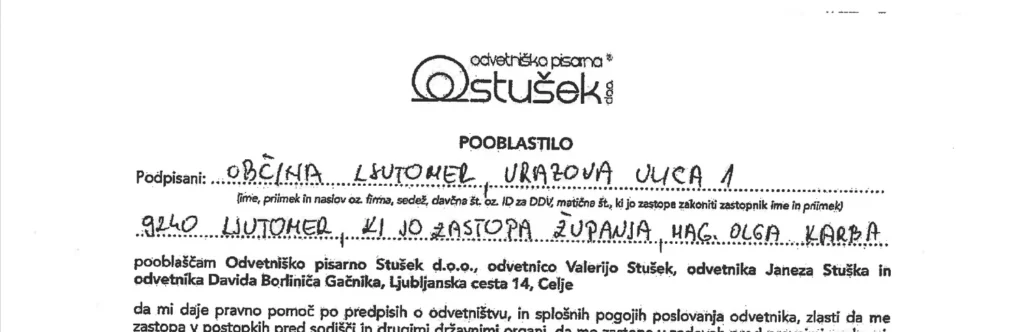
However, on Monday, October 20, the Municipality of Ljutomer notified the Information Commissioner and the Specialized State Prosecutor’s Office that it had concluded from Oštro’s questions that “the aforementioned entity processes and operates with numerous false and misleading data, including statements about real estate and mortgages that do not correspond to the actual situation”. The municipality claims that Oštro’s data “relates to persons who are not public figures, therefore its processing has no legal basis”.
To notify the Information Commissioner and report “suspected criminal offences related to the unlawful processing of data and dissemination of false information”, the municipality has authorized the law firm Stušek, owned by former Sova director Janez Stušek.
(This law firm represented the former owner of the bankrupt Kolosej, Sergej Racman, in one of the Slovenian SLAPP lawsuits, strategic lawsuits to prevent public participation, against the editor-in-chief of Oštro and former Delo journalist Anuška Delić.)
We asked the law firm whether the mayor would be responding to journalists’ questions. They replied: “The matter at hand is still being coordinated. Once our position has been agreed with the client, we will get back to you”.
The Journalists’ Association of Slovenia has already responded to the move by the Ljutomer Municipality, condemning “attempts to lower established standards of transparency in the country and schemes to silence journalists through lawfare”.
As they elaborated, journalistic investigations into the assets of public officials and associated persons are “undoubtedly in the public interest, as they contribute to transparency and oversight of the authorities and reduce the risk of corruption”. In this context, officials cannot consider “the publication of publicly available information in a manner that doesn’t disclose the personal data of officials’ family members to be illicit”. Even less can “such investigations be criminalized and legal means be used to exert pressure on journalists and media outlets that systematically monitor the assets of officials”.
Minister Jevšek and his ‘garage’
Meanwhile, the unusual ‘garage’ of Minister Aleksander Jevšek, which we discovered and reported on July, is being investigated by the Commission for the Prevention of Corruption, two inspection services, and the Maribor Institute for the Protection of Cultural Heritage. The Building Inspectorate informed Oštro that the inspection procedure began on October 3, nearly six months after the editorial office had brought the minister’s non-compliant construction in Filovski Gaj to its attention.
In accordance with the decision issued by the Inspectorate for Culture and Media on August 18, Mr. Jevšek submitted a timely application to the Institute for the Protection of Cultural Heritage in Maribor for the missing cultural heritage approval for one of the new building’s four plots. The institute inspected the site in Filovski Gaj on October 15. The cultural heritage opinion has not yet been issued, as the investor’s representative was asked to supplement the project documentation.
Before issuing her decision, the inspector rejected some of the minister’s statements recorded in the inspection report. As she stated in her decision, the minister had incorrectly claimed that his architect had already initiated the procedure for obtaining consent from the competent heritage protection authority. The inspector also questioned the minister’s claim that the building had been constructed in accordance with the building permit and cultural heritage consent, as the latter hadn’t been granted for one of the four relevant plots.

Some words of gratitude
Matjaž Švagan, mayor of Zagorje ob Savi, discovered new information in response to our questions – having found out that the bank hadn’t deleted the mortgage registered on the house he owns with his wife. He thanked Oštro for directing him at the issue, after which he took care of the land registry matters, as he had repaid the loan by selling an apartment.
Until 2020, Mr. Švagan owned two apartments in Izlake, which he had purchased much earlier, in 1993 and 2002, from the municipality of Zagorje ob Savi. He stated these were “two smaller apartments, which he combined into one residential unit when planning his family,” and later on sold.

According to land register data, the apartment was purchased five years ago by the couple Sergej and Metoda Smrkolj. Mr. Smrkolj is the director of the company Skitti, the buyer of undeveloped municipal building land in the Kisovec II Economic and Business Zone in 2023.
When asked if the municipality had taken any preventive measures during the public tender for the purchase of the property, given that the mayor and the buyer had been in a different, personal and business relationship three years earlier, Mr. Švagan replied that the land had been sold in accordance with the law, as confirmed by the municipal supervisory board, and that the Commission for the Prevention of Corruption reviewed his work and business operations and found no irregularities.
In its January report, the KPK indeed explained that it hadn’t confirmed the allegations that the mayor had committed irregularities in awarding funds to Skitti through the public tender for economic restructuring investment under the Just Transition Fund. To wit, the entire tender in this region was later annulled and repeated.
Some officials thanked Oštro for developing the Asset Detector: “I welcome your efforts to increase the transparency of our work,” said for example Neva Grašič, State Secretary at the Ministry of Foreign and European Affairs.
Estate, villa, stock portfolios
In this round of asset disclosures in the Asset Detector, Mayor Franc Čebulj of Cerklje na Gorenjskem and Mayor Robert Smrdelj of Pivka stand out in terms of their wealth.
After thirty years as mayor, Mr. Čebulj owns a tourist and agricultural estate on his inherited family farm in Adergas and its surroundings under Mount Krvavec, which is managed by his company Domačija Vodnik Adergas. He keeps a small holiday apartment in Mareda in Istria, Croatia.
According to data from the Central Securities Clearing Corporation (KDD), he also owns a large number of shares in Krka, Telekom Slovenia, Sava Re, and Triglav Insurance. As of August 20 this year, when we collected the share data, they were worth a total of €855,000 based on the average daily values published by the Ljubljana Stock Exchange.
In an interview for Oštro, the mayor explained that he has held the shares for many years, having purchased them while he was a member of the National Assembly between 1996 and 2004. He stated that he had “disposable funds at the time”, and that the shares cost him considerably less than they are worth today. He didn’t specify how much.
In a profile published on the SDS website in February, Romana Tomc only stated that she owned shares in Nova24tv, but in July 2024 she was the owner of shares in Krka, Port of Koper, Petrol, Sava Re, NLB, Telekom Slovenia, and Triglav Insurance.
MEP Romana Tomc also owns a substantial stock portfolio. In February this year, in her profile published on the SDS party’s website, she only said she owned shares in NTV24 (Nova24tv), but according to KDD data, as of July 18 2024, she owned shares of Krka, Port of Koper, Petrol, Sava Re, NLB, Telekom Slovenia, and Triglav Insurance.
A good year later, on August 20 this year, she was still the owner of these shares. Their total value, based on the average daily stock market values at the time, was nearly €540,000. Ms. Tomc provided no concrete response to journalists’ questions.
The mayor of Pivka, Robert Smrdelj, is the majority owner of Nemeza, a company engaged in the rental and operation of real estate according to Ajpes data. During his mayoral terms – he has been mayor since 1998 – he built a house with two apartments and two swimming pools on the Croatian island of Krk. According to the purchase agreement, he sold the larger apartment in 2022 for €380,000, while keeping the other apartment in the villa.
Ajpes data shows that Mr. Smrdelj is also a co-founder of the Pivka Local Acceleration Centre, established by the municipality in 1998. Data from Erar states that the centre received more than €1.1 million in funding from the municipality between October 2016 and August 2025. It is unclear how the mayor came to be a co-founder of the municipal accelerator, and we are still awaiting clarification on this matter. We will publish it when we receive it.
Mayor Smrdelj did not register this organization on the list of entities with restrictions on business activities with the public sector maintained by the KPK. In response to Oštro’s findings, the KPK among other explained that the mayor of Pivka, as co-founder, should have reported the local accelerator to the body where he performs his function, adding: “We will also investigate the circumstances in this case”.
At the end of last year, KPK data showed 24,327 persons subject to declaring their assets. Currently, the supervision of declarations is being carried out by “two employees”. This is one more than in May 2023, when Oštro first published data in the Asset Detector.
*The article in Slovene was published on October 23, 2025.
2026 © Oštro